Awards:
The image was selected as NASA’s APOD (Astronomy Picture of the Day) on October 5, 2026. NASA APOPD Astronomy Picture of the Day – 05. October 2026
It was also selected as the IOTD (Image of the Day) on astrobin on October 8, 2026.
Sombrero Galaxy M104 embedded in it’s Halo and Stellar Tidal Stream
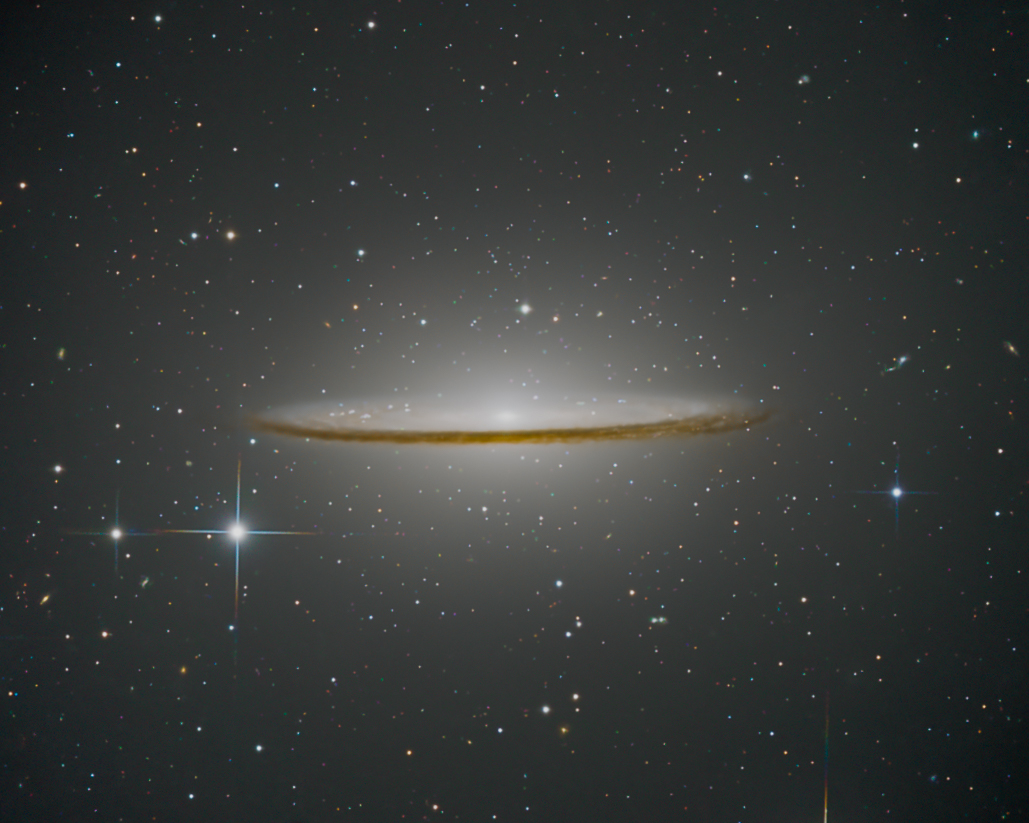
With its striking, hat-like appearance, the Sombrero Galaxy captivates observers in the night sky. We are looking at the galaxy almost directly from the side and can see a massive, dark band of interstellar dust and gas stretching across the bright core.
It has an unusually large, brightly glowing central bulge and a wide, round halo of billions of old stars. Hidden at the heart of M104 is one of the most massive black holes in our cosmic neighborhood, with a mass of about one billion solar masses—roughly two hundred and fifty times that of the black hole at the center of our Milky Way.
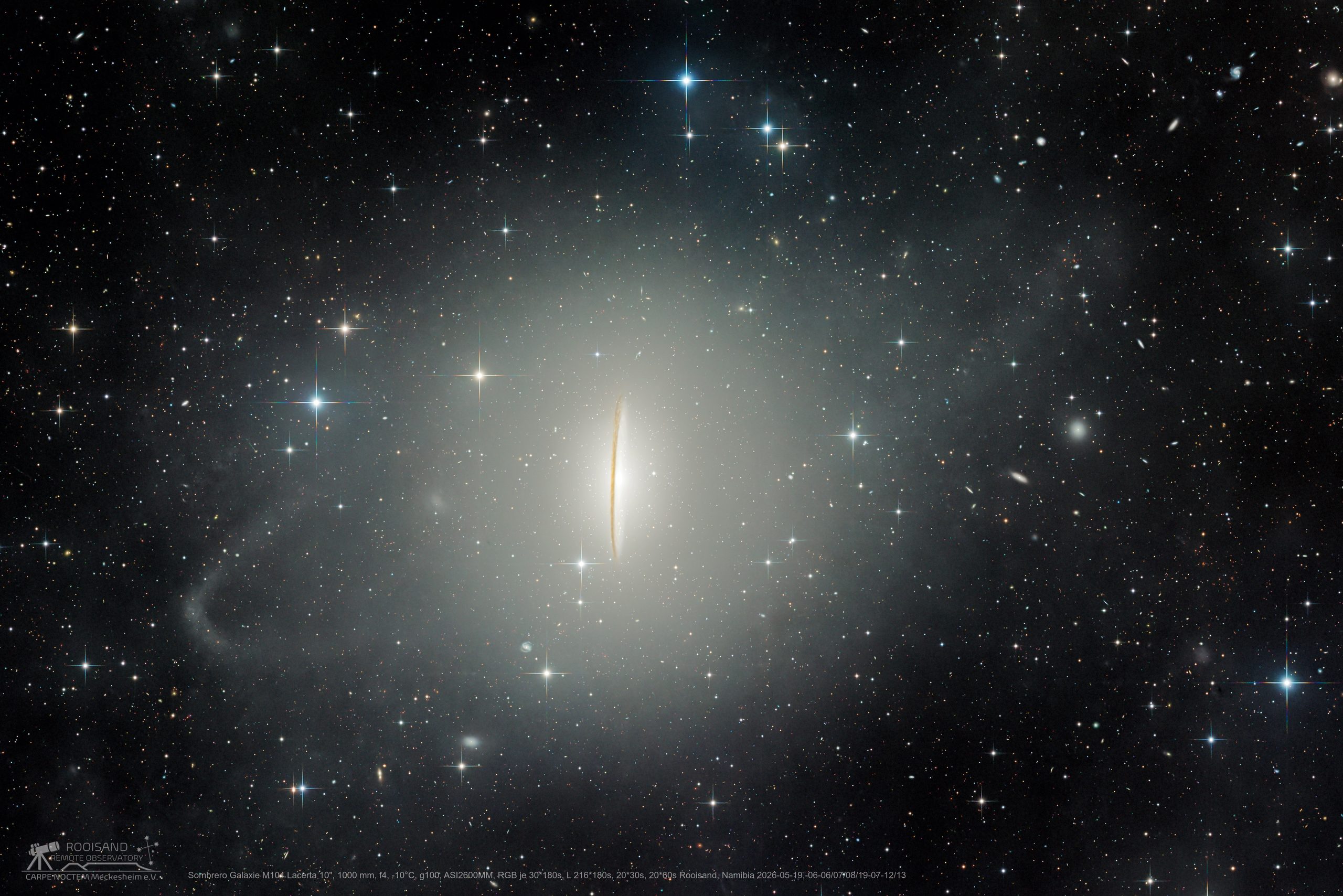
Although the Sombrero Galaxy appears completely symmetrical, peaceful, and smooth from the outside, its halo proves that it was a true “galaxy-eater” in its past. It is the chaotic legacy of a gigantic collision with another galaxy. My image, exposed for about 24 hours, shows this in detail. A massive, very faint stream of stars winds around the galaxy like Saturn’s rings. These are the remnants of a smaller satellite galaxy that was literally torn apart and absorbed by the enormous gravitational forces of the Sombrero Galaxy.
The galaxy and its stars are about 30 million light-years away from us, which is why the halo and stellar stream are so faint. The average surface of the Sombrero Galaxy is about 500 times brighter than the brightest part of its stellar stream. If one compares the galaxy’s extremely bright center with the faintest outer reaches of the stream, the galaxy is actually more than 10,000 times brighter there. And the stream is more than 150 times fainter than the natural, dark night sky. Images can therefore only be captured with very long exposure times and under a completely dark sky (e.g., in Namibia).
Date
Location
Exposure Time
Telescope
Camera
May / June /July 2026
Rooisand, Namibia
Luminance 18 hours; R, G, B each 2 hours
Lacerta Newton 10″ f4
ZWO ASI2600MMP