Embedded in a vast halo of neutral hydrogen, a striking galaxy shines in the constellation Sculptor, its appearance reminding one of a coin viewed at an angle, the Silver Dollar Galaxy, also known as the Sculptor Galaxy. It is 11
Read more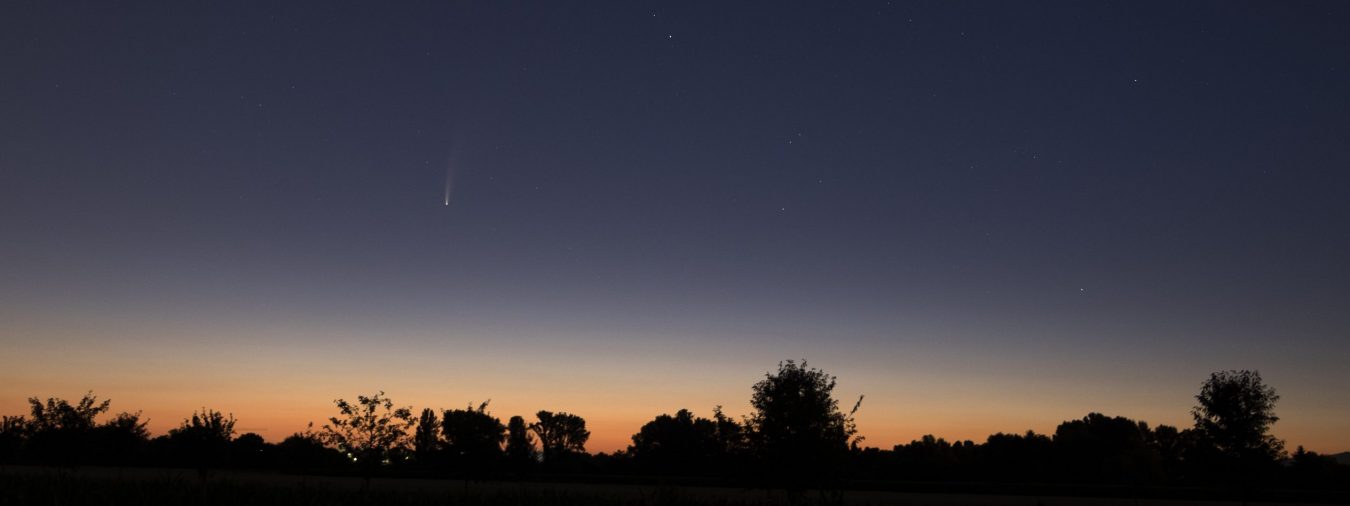
Silverdollar Galaxy NGC 253
Sombrero Galaxy M104
Awards: The image was selected as NASA’s APOD (Astronomy Picture of the Day) on October 5, 2026. NASA APOPD Astronomy Picture of the Day – 05. October 2026 It was also selected as the IOTD (Image of the Day) on
Read moreA Sandworm in the Southern Celestial Serpent MW9
Like a giant sandworm, this enormous stream of interstellar gas and dust winds its way through the sea of stars. My image shows a small section of a vast cloud that meanders across the southern sky. MW9, the Southern Celestial
Read moreTrifid Nebula – M20
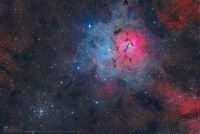
The Trifid Nebula (M20) is a rare combination of a red emission nebula, a blue reflection nebula, and dark dust lanes. An extremely hot, young multiple star at its center has so much energy that it causes hydrogen gas to
Read morePart of the Dark-Wolf-Nebula
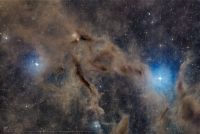
My image shows a small section of the Dark Wolf Nebula. This nebula, in turn, is part of the large molecular cloud in the constellation Lupus (the Wolf), about 500 times the size of our full moon and only about
Read moreMermaid Nebula – ESO 217-25
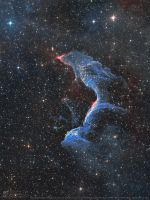
An impressive sea creature in the constellation Centaurus. My image shows the ghostly remnant of a stellar explosion, often referred to as the “Mermaid Nebula.” What appears here as an elegant web of luminous blue filaments and red shock fronts
Read moreSkull and Bones Nebula NGC2467
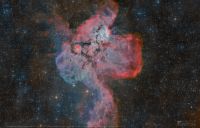
In my image, nebulae, numerous colorful stars, and star clusters form a vibrant portrait of the cosmos, also known as the Skull Nebula. At its center, in the bright white region at the top, lies a gigantic star. Just like
Read moreCosmic Bat Nebula NGC1788
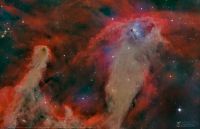
Two column-like dark clouds composed mainly of dust dominate my image. They are framed by glowing red hydrogen clouds. These dark clouds are illuminated by the many stars of the Milky Way, reflecting their light and thus becoming visible to
Read moreComet C/2024 E1 Wierzchos
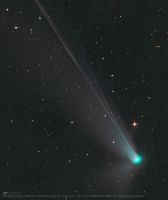
The bright comet C/2024 E1 Wierzchos reaches us from the edge of the solar system, the Oort Cloud. It appears with two narrow gas tails and a faint, broad dust tail. But we can also see a second tail, the
Read moreAngel Nebula NGC 2170
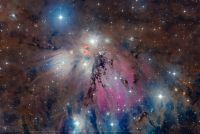
My colorful photo shows the Angel Nebula in the constellation Monoceros. A nebula complex that combines a mixture of the most beautiful types of nebulae. Bluish nebulae that reflect the light of nearby hot stars. Hydrogen clouds that are excited
Read more