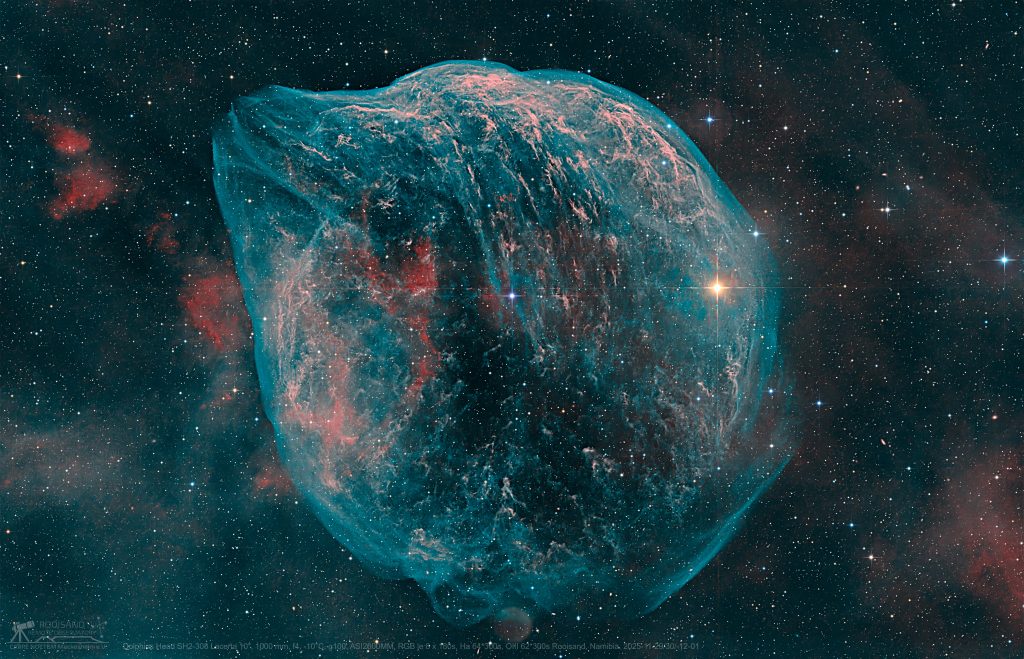
The sky is full of beautiful phenomena, which are impressively displayed here with the Dolphin Head Nebula. This colossal gas bubble is the result of a catastrophic stellar wind emitted from one of the rarest and most unstable types of stars, a Wolf-Rayet star, in this case the star EZ Canis Majoris. These stars live only a short time, a few hundred thousand years, and eventually die as exploding supernovae, ejecting huge amounts of heavy elements into space. In my image, it is the fainter, bright star in the center of the nebula.
As a red supergiant, the star EZ Canis Majoris had shed its outer hydrogen envelope, creating an extensive bubble. Later, it produced much faster stellar winds, consisting mainly of helium and heavier elements, flying outward at speeds of up to 1,700 kilometers per second. When these winds collided with the slower material from the earlier phase, they created a powerful shock wave that compressed the interstellar gas into the thin, dense shell with its sharp, blue-green edges.
Also, at the lower edge of the main nebula is a smaller, almost perfectly spherical celestial object, most likely a planetary nebula.