In my image, nebulae, numerous colorful stars, and star clusters form a vibrant portrait of the cosmos, also known as the Skull Nebula. At its center, in the bright white region at the top, lies a gigantic star. Just like
Read more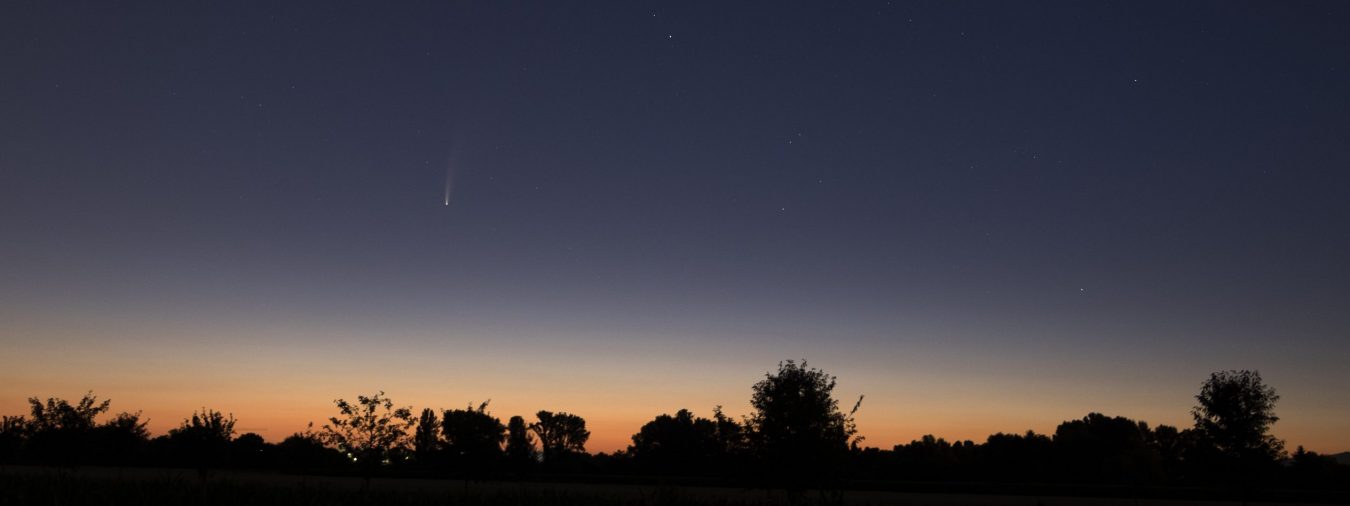
Skull and Bones Nebula NGC2467

Southern Milkyway

The Earth rotates, and with it, the stars appear to circle the celestial South Pole above Namibia. In my composition, I captured the Milky Way and the two neighboring galaxies, the Magellanic Clouds, at the start of the session and
Read moreCosmic Bat Nebula NGC1788

Two column-like dark clouds composed mainly of dust dominate my image. They are framed by glowing red hydrogen clouds. These dark clouds are illuminated by the many stars of the Milky Way, reflecting their light and thus becoming visible to
Read moreComet C/2024 E1 Wierzchos

The bright comet C/2024 E1 Wierzchos reaches us from the edge of the solar system, the Oort Cloud. It appears with two narrow gas tails and a faint, broad dust tail. But we can also see a second tail, the
Read moreSeven Sisters, M45 Pleiaden

Due to their conspicuousness, the Pleiades have been known in almost all cultures since ancient times. However, their name Seven Sisters is misleading, because even with the naked eye, six or more than seven stars can be seen. The Pleiades
Read moreAngel Nebula NGC 2170

My colorful photo shows the Angel Nebula in the constellation Monoceros. A nebula complex that combines a mixture of the most beautiful types of nebulae. Bluish nebulae that reflect the light of nearby hot stars. Hydrogen clouds that are excited
Read moreDolphin Head Nebula – SH2 308

The sky is full of beautiful phenomena, which are impressively displayed here with the Dolphin Head Nebula. This colossal gas bubble is the result of a catastrophic stellar wind emitted from one of the rarest and most unstable types of
Read moreLBN 878 and Barnard 35 in Orion

This beautiful combination of the dark cloud Barnard 35 and the brown and reddish glowing emission nebula LBN 878 framing it can be seen in the constellation Orion. Like other dark nebulae, Barnard 35 consists of interstellar gas and dust
Read moreVeil Nebula in Cygnus – NGC 6995, NGC 6920

This cirrus cloud-like nebula is the last visible remnant of a star that exploded in the Milky Way about 8,000 years ago. For people living at that time the expanding cloud was as bright as a crescent moon and visible
Read moreIC1613 – Dwarf Galaxy in Cetus

After upgrading our telescope in Namibia, we took an image of the fascinating dwarf galaxy IC1613 which was visible in the sky all night long. Located 2.3 million light-years away, it contains around 100 million stars and has an irregular
Read more