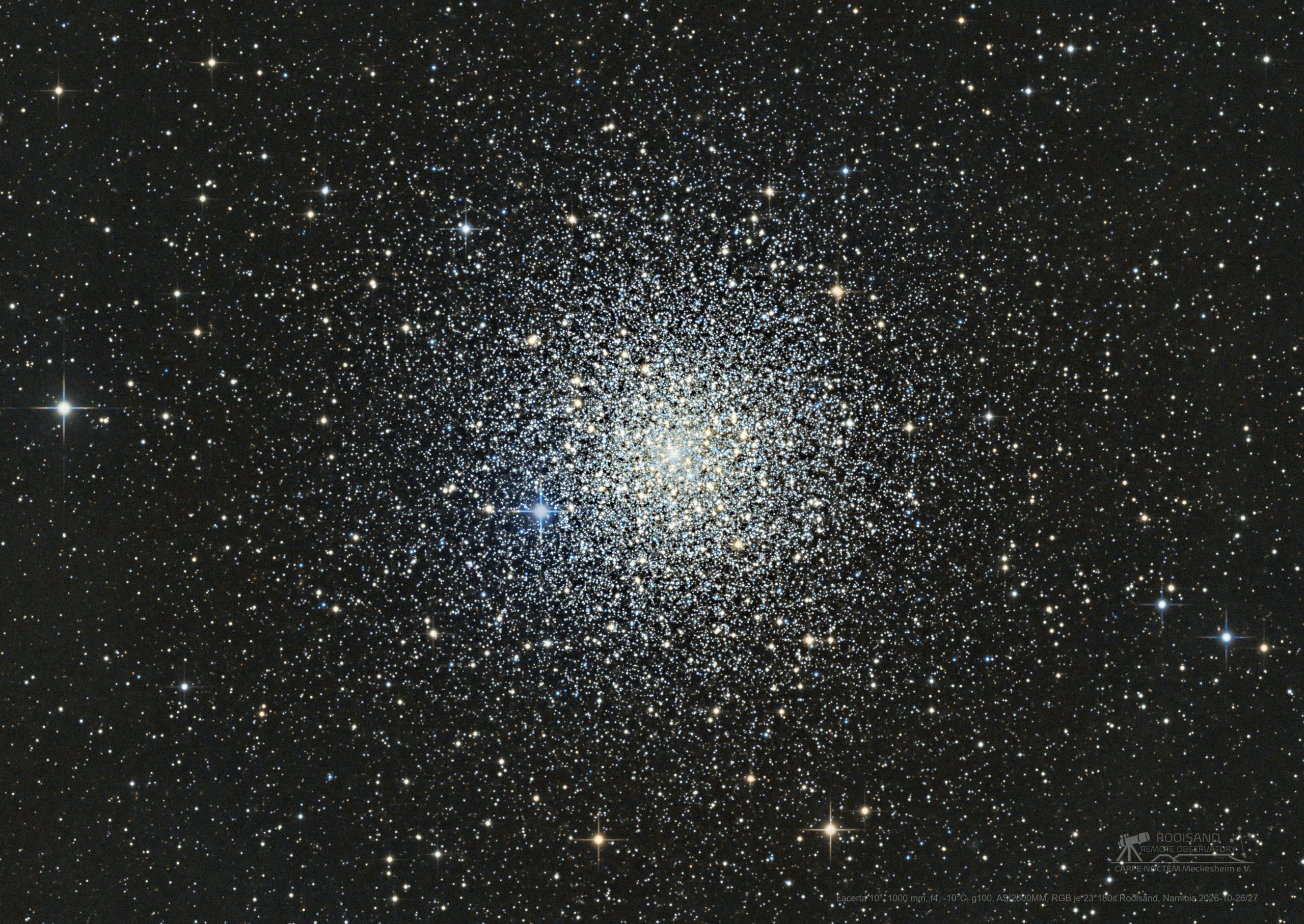
Over 100,000 stars form the Great Peacock Globular Cluster NGC6752 for more than 11 billion years. On the outer edges, hot stars stand out as pinpoint-sized blue-white dots, while toward the center, a core of yellow-white stars dominates. Why is that?
Heavy, yellow stars, known as Red Giants, lose kinetic energy during close encounters with other stars and, over the course of billions of years, drift toward the center of the cluster. Lighter, blue-white stars gain energy thereby and are thus literally pushed outward. If you look very closely, you’ll also spot isolated, extremely bright blue dots in the center. These are Blue Stragglers, stars that merged into heavier ones through collisions and have also sunk to the very center. Another effect for this color separation is that the Red Giants have enormous luminosity and thus simply outshine the smaller blue stars.
The very bright, large stars with distinct ray patterns (such as the bright blue star to the left below the core) are mostly foreground stars in our Milky Way. They happen to lie exactly in our line of sight, but are actually closer to us than the globular cluster in the background.