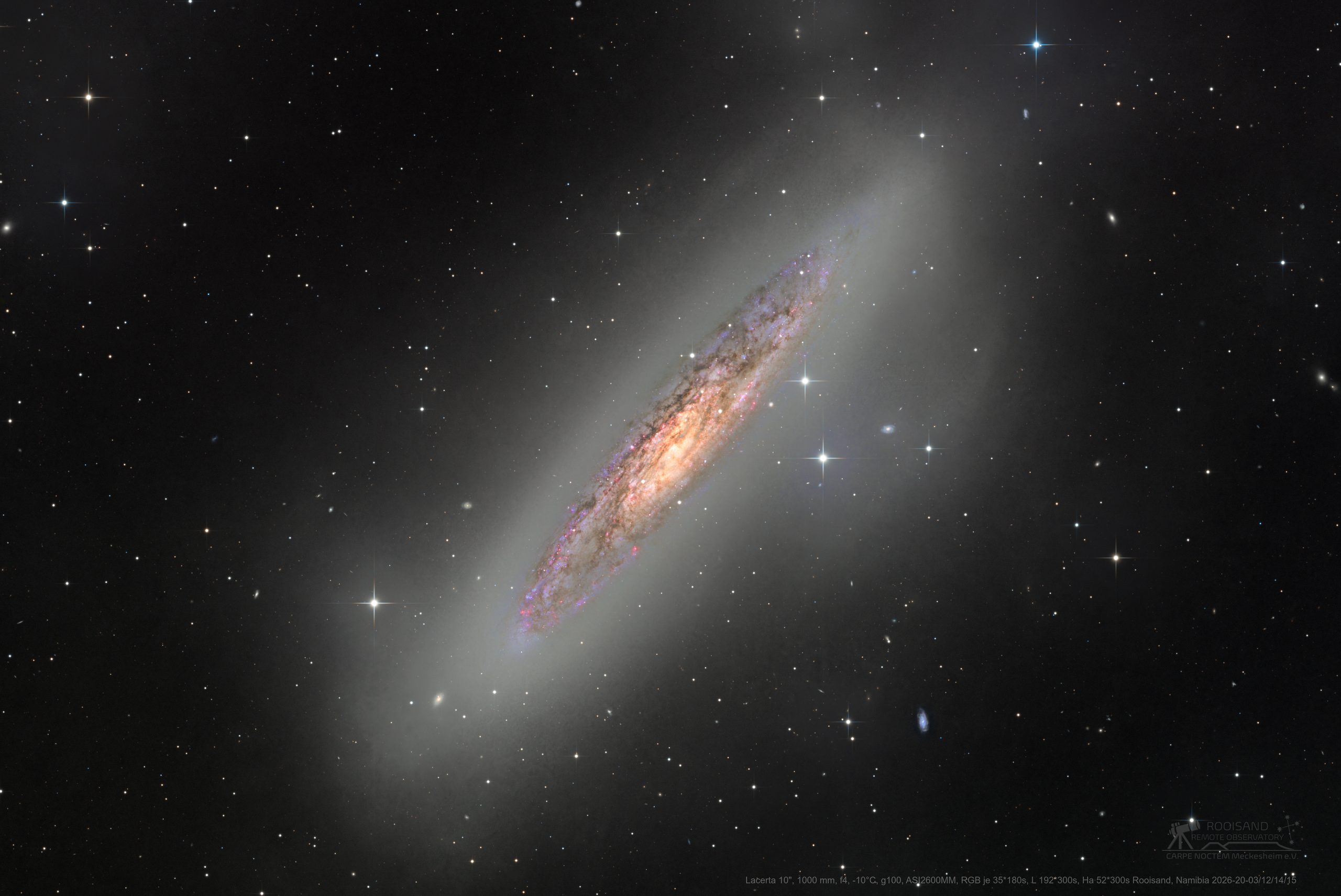
Embedded in a vast halo of neutral hydrogen, a striking galaxy shines in the constellation Sculptor, its appearance reminding one of a coin viewed at an angle, the Silver Dollar Galaxy, also known as the Sculptor Galaxy. It is 11 million light-years away and 70,000 light-years across. Most striking are the many glowing red star-forming regions and dark dust lanes. It is what is known as a starburst galaxy; huge and very compact clouds of gas and dust are giving rise to an extremely large number of new stars within it. Supernova explosions of old stars and radiation from bright stars generate powerful winds of gas and plasma, ejecting them into space. Much of this consists of vast quantities of cold hydrogen and carbon monoxide, which collapses at higher altitudes, cools, and falls back into the galaxy. This gas forms the halo, approximately 30,000 light-years in size, that my image shows. A 26-hour exposure in the dark skies of Namibia makes such images possible.
Date
Location
Exposure (Std)
Telescope
Camera
October 2026
Rooisand, Namibia
Luminance: 16 ; R, G, B: ea. 2 ; Ha: 4,5
Lacerta Newton 10″ f4
ZWO ASI2600MMP